things to do
landing beaches & museums
Early on the morning of June 6th 1944 7,000 ships of all sizes approached the coast on Normandie. This was the largest flotilla the world had ever seen, and has never been surpassed. The 5 beaches selected for the landings have been known by their code names ever since – the two American beaches, Utah and Omaha, the two British Beaches, Sword and Gold and the Canadian Beach, Juno.


You’ll be spoilt for choice of things to do in Normandie connected to the WW2 sites and memorials.
Visitors today can explore old army bunkers, tanks and Atlantic Wall defences along the five beaches: Utah, Omaha, Gold, Juno and Sword while all the museums and memorials throughout the region stand as forceful and poignant reminders of this decisive period of the Second World War.
Our nearest beach, Omaha Beach is one of the largest of the five Landing beaches. The future of France and Europe was at stake here on 6th June 1944. When you visit this beach which extends over Vierville-sur-Mer, Saint-Laurent-sur-Mer and Colleville-sur-Mer, you’ll gain a clearer idea of the progress of the battles and it will touch you deeply. Today it is a place of pleasure and fun but it will always remain as a poignant place to take a moment and remember all who lost their lives there 80 years ago.

The British Normandy Memorial
The British Normandy Memorial at Ver-sur-Mer, stands up on the hill, poignantly overlooking Gold Beach, one of the two beaches where British forces landed on 6 June 1944.
The entrance path is lined with stone plinths depicting the Battle of Normandy, telling the story as you approach the Memorial itself.
In the centre is a D-Day wall with the names of the 1,746 people who lost their lives on June 6, 1944 and on each side stand 160 white columns inscribed with the names of those who died on the following days, in chronological order, clockwise from the centre. The columns have the names of 22,000 of British soldiers, sailors, marines and airmen who lost their lives on D-Day and in the weeks that followed, alongside the names of men and women from more than 30 different countries.
To the west of the site is a memorial dedicated to the 20,000 French civilians who not only lost their lives during the Battle of Normandy, but also to the many others who were injured or whose homes were destroyed.
The Memorial is a place for remembrance and reflection, where future generations can come to understand the scale of what happened in Normandy in 1944, and the UK’s role in securing Europe’s freedom.

The American Cemetery
The American Cemetery at Colleville was inaugurated in 1956 and is laid out in an area of 170 acres which was ceded to the United States by the French government. The visit begins by the Visitor Centre where the details of Operation Overlord are explained.
Outside, a viewpoint diagram placed in front of a water mirror, shows the beaches where the Allied forces landed. Looking to the West you can see the cemetery and behind it, a round chapel. The cemetery contains 9,387 gravestones perfectly aligned on a majestic expanse of green lawn. Every day, at the end of the afternoon visitors can watch the ceremony of the Lowering of the Colours to the sound of a military hymn as the American flag is lowered and folded.

D Day Garden Arromanches
The Arromanches D Day garden pays tribute to the veterans of the Battle of Normandy. Known as D-Day 75 Garden and was first exhibited at the RHS Chelsea Garden Show in May 2019.
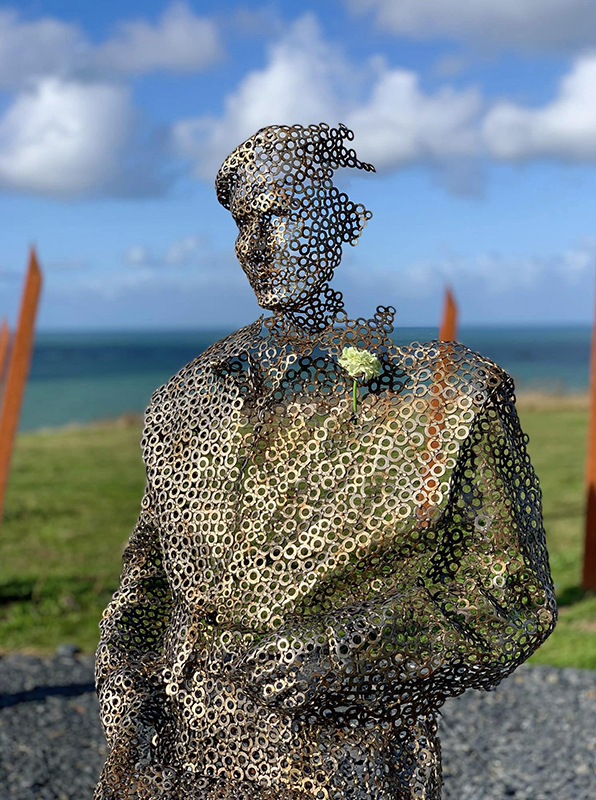
This beautiful, poignant garden of statues made of welded metal washers sits high on the cliff over looking overlooking Arromanches and the Mulberry Harbours in its ‘final resting place’ overlooking the site where the Allied troops landed on Gold Beach below on 6 June 1944.
There is something very etheral, peaceful and poignant about the sculptures as you can see through them to the beach below, their bodies are only partially there and they seem to appear out of thin air in an evocative tribute to the fallen.
At the entrance to the garden, a statue of veteran Bill Pendell sits on a stone plinth wearing his medals and beret. He looks across at another sculpture of his younger self about to land on D-Day. Four further sculptures of soldiers show them wading through the waves as they navigate the obstacles on Gold Beach.
Statue les Braves
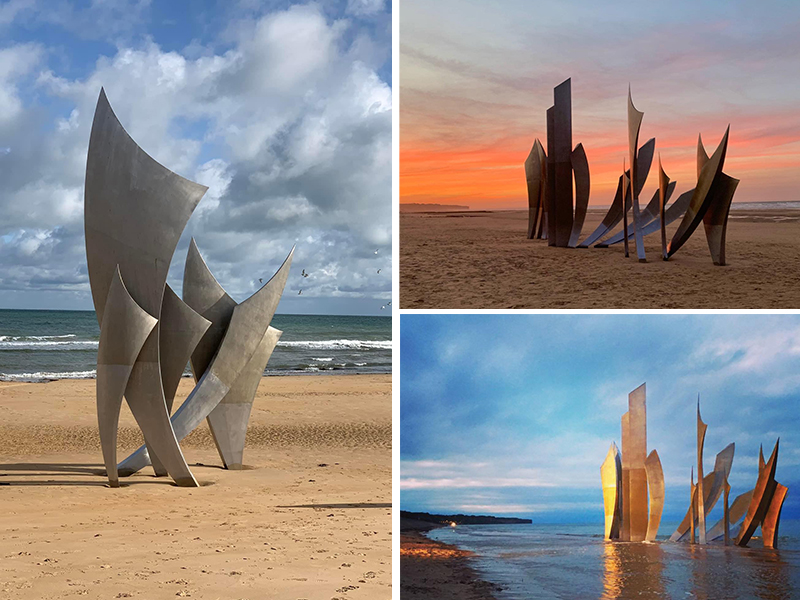
On the sand of Omaha Beach, at Saint Laurent-sur-Mer, stands the Statue des Braves. This steel sculpture is a fine homage in honour of the soldiers who landed here on 6th June 1944.

D-Day Experience
This is much more than a museum – its an immersive and interactive journey to understand the landing of the airborne troops on D-Day.
You’ll start by being led to a briefing room for a 3-D briefing with the Colonel who will brief you on your mission. Then, you’ll board a real airframe C-47 for a unique simulated flight. It will make your heart race a little as you relive the Channel crossing in the shoes of a paratrooper.On landing you’ll disembark the plane and enter a fascinating and authentic collection, the museum is the living memory of the allied troops – we even saw the gate that belonged to a friend of ours who now owns the property where the 1st American Field Hospital was situated – that really brought it home to us with that tangible item that was on his property all those years ago and now rests in the museum.
You can also visit the original house called Dead Man’s Corner which portrays the German elite troops and tells the story of those days in a different manner.
There are two shops (one with original militaria and a gift shop) where the emphasis is placed on the authenticity and quality of the objects displayed.
GOLD BEACH Arromanches
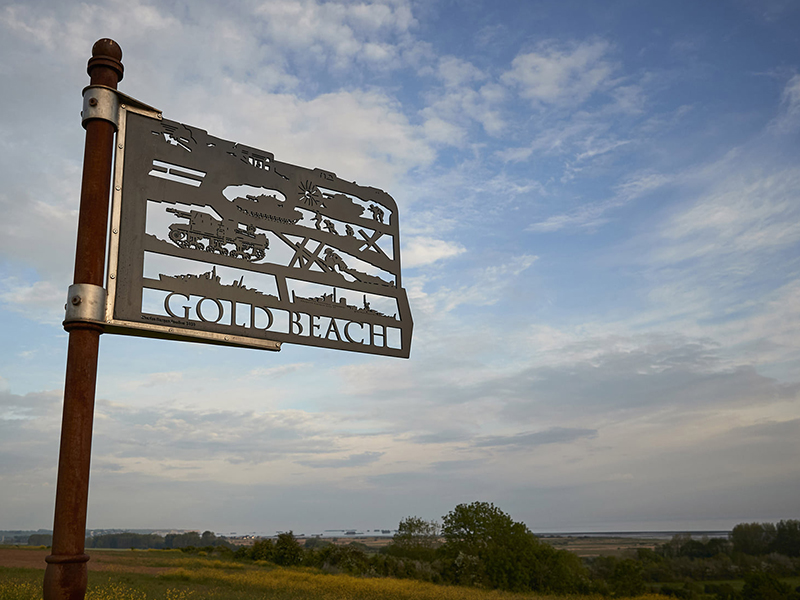
Gold is the code name for the centre beach of the invasion area. It is 8km long and located between the villages of La Rivière to the west and Le Hamel to the east. Landing on this beach was the task of the 50th Northumbrian Infantry Division.
Arromanches was in the forefront of the Normandy landings after its beach, designated Gold Beach during the operations, was one of the beaches selected to receive the man-made landing harbours, known as the Mulberry Harbours.
The beach is a lovely long stretch of golden sand and the town has a pleasant, lively atmosphere and there are plenty of bars, hotels and restaurants to make this a lovely place to visit. Remains of the Mulberry Harbour are still visible, with a couple of the concrete harbours on the beach and another line of them to be seen in the sea. To see them up close is quite evocative.
Arromanches is also home to a new museum, the Museum of the Normandy Landings and above the town on the hill is the 360° cinema. The film contains archive footage of the D-Day landings and immerses the visitor in a recreation of the experience. As you depart the cinema you can look down onto the beach and Mulberry Harbour from the poignant D-Day garden with its washer soldiers.

Omaha Beach St. Laurent-sur-Mer
Omaha is the code name of the American lead landing beach in Normandy where the 29th Infantry Division and the 1st Infantry Division came ashore in the WWII D-Day invasion.
Today, the beach is a place of freedom, reflection but also a place for enjoyment and water sports for all the family.
On the shore, the beautiful stainless-steel sculpture Les Braves commemorates the bravery of the American soldiers and the freedom they fought for.
The cliffs behind the beach are still dotted with the remains of German bunkers and are the site of a memorial and the American Cemetary.
The largest of the D-Day assault areas, Omaha Beach stretched over 10 km (6 miles) between the fishing port of Port-en-Bessin on the east and the mouth of the Vire River on the west.
The Juno Beach Centre
The Juno Beach Centre is a museum and cultural centre at Courseulles-sur-Mer. The Centre presents the war effort made by all Canadians, civilian and military alike, both at home and on the various fronts during the Second World War.
Overlord Museum
Located at a short distance from Omaha beach the Overlord museum chronicles the period of the Allied landing until the liberation of Paris. Personal items from individual soldiers and armoured fighting vehicles from the six armies in Normandy will be presented as a series of reconstructions showing over 35 vehicles, tanks and guns.
Battle of Normandy Memorial Museum
Just a short drive from Le Pressoir in nearby Bayeux you’ll find the the Battle of Normandy Memorial Museum that retraces the key events that led to Bayeux becoming the first town in France to be liberated, on the morning of 7th June 1944.
Pegasus Bridge
The capture of the River Orne bridge at Ranville and the bridge across the Caen canal at Bénouville is the most famous mission of the airborne division. In less than ten minutes both bridges had been captured intact. On June 26th 1944, the bridge was baptised Pegasus Bridge as a tribute to the British troops. Pegasus, the winged horse, was the emblem of the airborne division.