
This week I’m getting all nautical as I’ve recently found out about a fabulous sounding exhibition in Honfleur featuring a very special boat that plays an important part in both French and British history.
So let’s go and find out more… in fact let’s discover Mora!

All the way back in 1066, Guillaume was Duke of Normandy, but that wasn’t enough for him – he had bigger plans and that is how he became William the Conqueror!
He set his sights across the channel (La Manche) and so embarked on a journey to conquer England, after an extraordinary naval levy.
In record time, barely 10 months, William assembled a fleet of more than 700 ships capable of transporting not only food and weapons, but also horses and an army of thousands of men.
And the pride of his fleet was La Mora, Williams’s flagship, she was the largest and fastest ship in his invasion fleet.
Mora was given to Guillaume by his wife Mathilde.
Fast forward to today and you can set sail on a fabulous, immersive journey at the Jetée Est in Honfleur where the museum exhibition and show will bring the flagship of the conquest of England back to life.

Its reconstruction has been as authentic as possible and is part of an experimental archeology project. It is based on the iconography of the famous Bayeux Tapestry, and has been brought to life by a dedicated team of experts in Norman maritime history and maritime archaeology, naval architects, marine carpenters, etc.

The fact that this beautiful ship has come to life is truly amazing as the tapestry is the only visual representation of the Mora.
The Bayeux tapestry, a 70 metre-long (230ft) embroidered account of the Norman Conquest, depicts the Ducal ship, La Mora as a Viking-style longship with a striped red and gold sail flying the papal banner on its masthead, its stern figure in the shape of a character extending its arm towards England and its lantern blessed by the Pope.. On board was William, his most trusted knights, their entourage and horses, and 60 oarsmen.
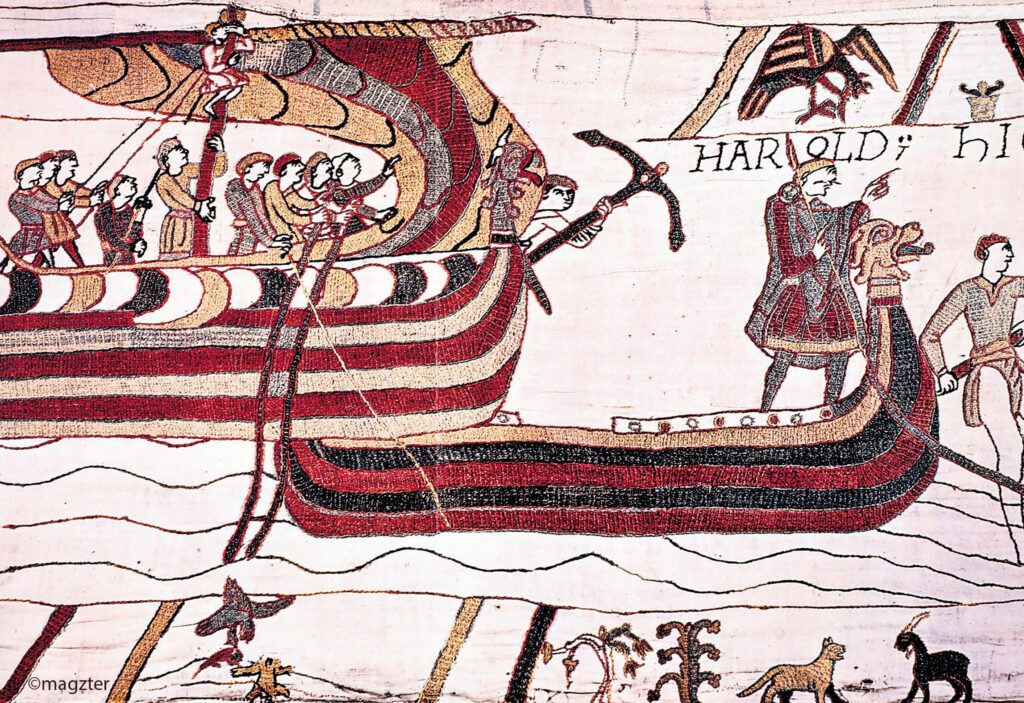
The rest, as they say, is history… King Harold was defeated in the Battle of Hastings 17 days later, and the Norman duke became William the Conqueror, King of England.

Here’s the show bit –
From the moment you enter, you’ll be immersed in the dark and magical atmosphere of Nordic mythology explaining the contribution of the Vikings to Normandy in centuries past. The preparations for the expedition to England, the crossing itself and on to the Battle of Hastings is also at the heart of the scenography.
Through the magic of special effects, you’ll be able to hear the wood cracking, feel the horses breathing, the wind rising and the rolling of the boat heading towards England.

La Mora reconstruction spectacle is accompanied by an immersive scenographic and educational project recounting the formidable epic of the conquest of England and, more broadly, the maritime history of Normandy.
Using light shows and special effects, reconstructed sets and touch screens, you’ll be placed at the heart of the story like a live experience. A voiceover, that of a shipwright descended from the Vikings, will guide you throughout the visit.

Check out their fascinating website, just click the language you need.
And here’s the science bit –
La Mora was a ship of Drakkar design and clinker construction built at Barfleur in Normandy, a gift of Matilda of Flanders to her husband William the Conqueror in the summer of 1066. She was a larger ship and carried ten knights with their entourages and equipment. The ship was captained by Stephen Fitz Airard, meaning the son of Airard, who remained her captain until William’s death in 1087. Stephen received lands in Hampshire, Berkshire, and Warwickshire as reward for his services in the English campaign of 1066.
The meaning of her name isn’t known although there have been several suggestions – She may have been named for the Morini, the ancient inhabitants of Flanders, as a reference to Matilda’s Flemish origins.
And here’s a bit Mora….
Let’s end with an animation of the reconstruction –
Happy Sailing.
Brilliant – such an interesting read.